As we get closer and closer to 2025, it is impossible to deny the broad impact technology has had on education. For many decades, teaching, learning, and relating knowledge have radically evolved, and the future promises even more exciting changes.
With technology taking over the face of the earth, education no longer has to be restrained between the brick-faced walls of the traditional classroom. The students have evolved in such a manner that they access information differently, interact with their peers, and even experience learning differently.
Teaching Historic Events Through Technology
The most interesting possibility for education in 2025 is the ability to teach historical events using highly advanced technologies without ever stepping into the classroom.
Virtual Reality (VR) and Augmented Reality (AR) will be the source for students to experience history in the Jubilee Year 2025, making something impossible possible. For example, a class can virtually be present at the celebrations or go through immersive experiences explaining the cultural and historical importance of the Jubilee Year. VR simulations could take students inside pivotal historical moments, while AR would overlay information onto real-world surroundings, allowing digital recreations of the moment to be available in real-time for learning.
The Emergence of Digital Learning Materials
More digital learning tools are on the way. The use of digital learning tools has become one of the significant trends of modern education. Today, online learning systems such as Google Classroom, Moodle, and most modern e-learning systems streamline everything: getting one’s own access to the necessary resources, connecting with instructors, and communicating with fellow students from all over the world.
In this context, we predict that in 2025, there will be a stronger emphasis on cloud-based tools that can make learning flexible, scalable, and accessible to everyone.
Educational technology could be used much more extensively in 2025, systems of AI-driven tutoring, self-paced for each learner and adjusted according to the learning style and individual pace of the learner, will have opened the door to education much more equitably—just as students in advanced sciences in the busy city or in mathematics in a remote village may learn more easily.
Artificial Intelligence for Personalized Learning
Increasingly, Artificial Intelligence is being used to offer much more personalised learning material. For instance, AI-based systems allow for tracking a student’s current strengths and weaknesses, adjusting material in response to a student’s learning preferences, and even delivering near-immediate feedback.
Well, by 2025, AI power will be absolute and dramatic. Smart tutors would provide personalised one-on-one learning support, while adaptive learning algorithms would adjust the lesson plan to meet different needs. On the latter aspect, teachers would also enjoy using AI tools meant for grading, monitoring the student’s performance, and knowing what areas need support.
Therefore, this trend towards personalisation will make education more accessible and inclusive for students with different needs. Whether or not a student learns differently, has an alternative educational background, or suffers from learning disabilities, AI opens up more tailored and supportive education systems.
Technology in the Classroom of Tomorrow
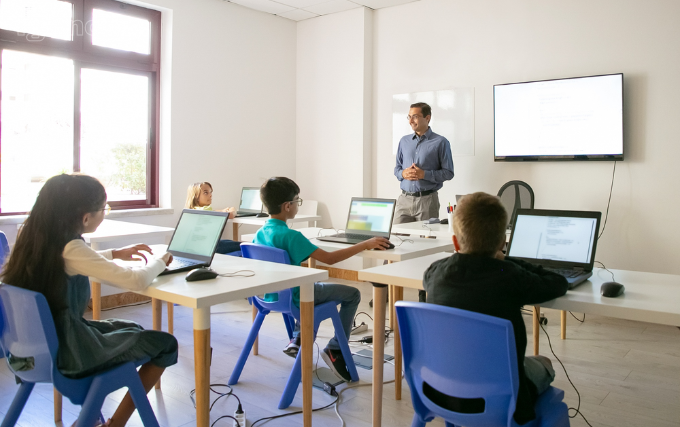
Of course, the tools will change, but the educator is at the very centre. In 2025, the teacher will guide students as they learn how to navigate their world with new forms of technology. In this method, instead of the teacher as a source of information, the student will use the instructor as a facilitator for solutions to those problems that require critical thinking and application of the tools and technologies available.
Instead, it would be the class of 2025 which would greatly engage via the dynamic mash-up of technology and traditional teaching and learning. The advanced digital tools should be more interactive. Such developments through collaborative online platforms and immersed technologies like VR simulation, AR, etc. would make a difference wherein students would be experimenters and creators rather than just consumers of information.
The Future of learning
Learning today is enjoyable indeed, and 2025 sits right at the entrance of a transformative era. Indeed, we know that classrooms tomorrow will be starkly different from today, as technological innovations continue to reshape teaching and learning. From AI-driven personalization to virtual field trips, the possibilities are limitless.